

If you have ever asked a supplier for a sodium citrate quote and received two prices with two different words attached, “food grade” and “pharma grade”, you already know the confusion this causes. Both look the same on paper. Both are white, crystalline, and highly soluble. Both list a purity of 99% or higher.
So why does one cost more? And more importantly, which one does your business actually need?
Choosing the wrong grade is not just a paperwork issue. It can hold up a shipment at customs, fail a customer audit, or worse, get flagged during a regulatory inspection.
In this guide, we will break down exactly what separates food grade sodium citrate from pharma grade sodium citrate, how each is tested, and how to choose the right one for your formulation.
What Is the Difference Between Food Grade and Pharma Grade Sodium Citrate?
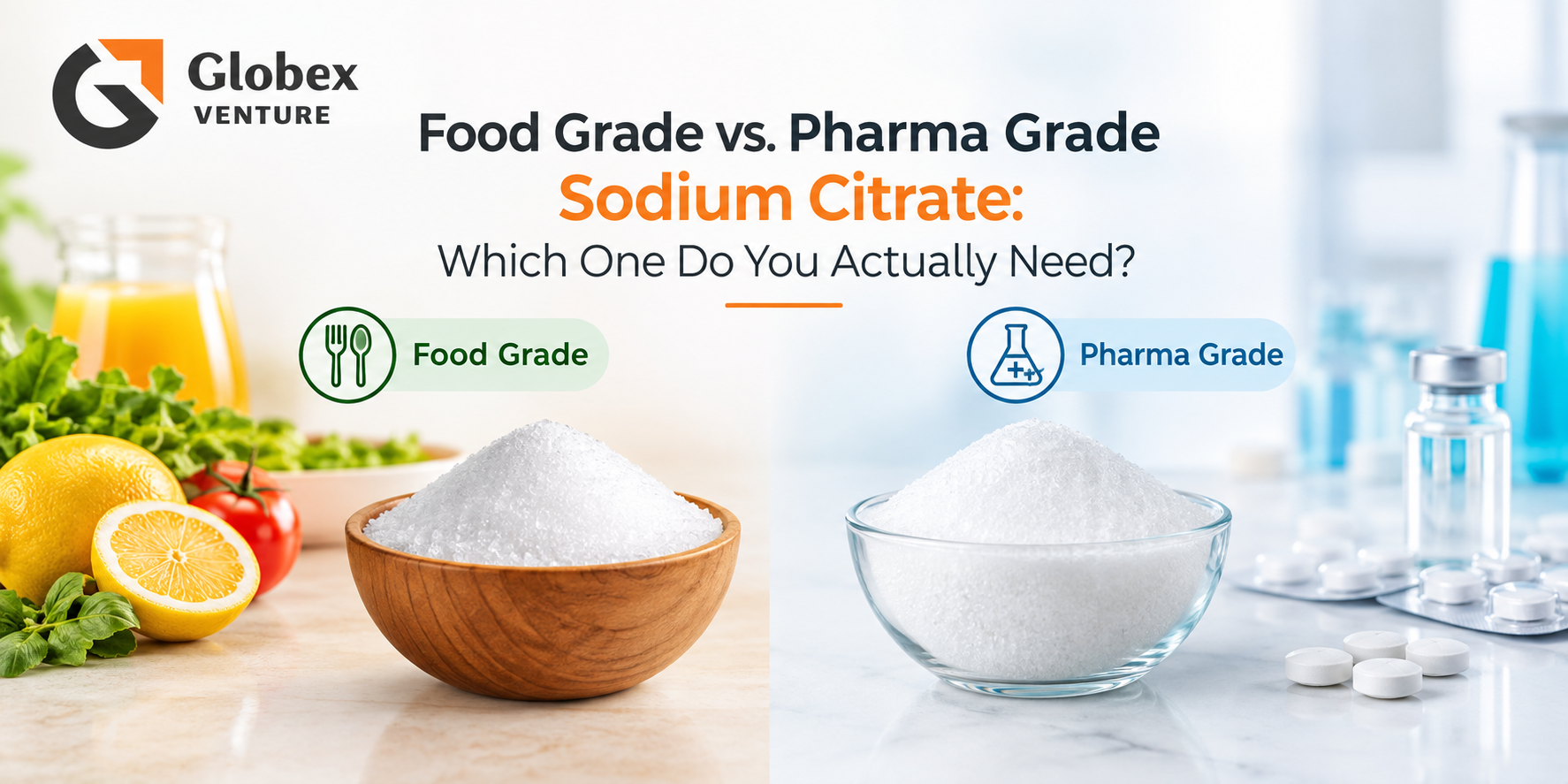
Both grades are the same molecule: tri-sodium citrate dihydrate (Na₃C₆H₅O₇ · 2H₂O). The chemistry does not change. What changes is the standard the product is manufactured and tested against.
- Food grade sodium citrate is qualified against food-additive standards such as FCC (Food Chemical Codex) and the EU’s E331(iii) designation. It is built for use in food, beverage, and general consumer formulations.
- Pharmaceutical grade sodium citrate is manufactured and tested against pharmacopeial standards such as USP (United States Pharmacopeia), NF (National Formulary), or BP/Ph. Eur. (British Pharmacopoeia / European Pharmacopoeia). It is built for use in drug formulations, injectables, and blood collection tubes.
Both grades typically fall in a similar assay range of 99–101% purity. The real difference sits in what else is tested, how tightly it is controlled, and what documentation backs it up.
What Is the Difference Between Food Grade and Pharma Grade Sodium Citrate?
Both grades are the same molecule: tri-sodium citrate dihydrate (Na₃C₆H₅O₇ · 2H₂O). The chemistry does not change. What changes is the standard the product is manufactured and tested against.
- Food grade sodium citrate is qualified against food-additive standards such as FCC (Food Chemical Codex) and the EU’s E331(iii) designation. It is built for use in food, beverage, and general consumer formulations.
- Pharmaceutical grade sodium citrate is manufactured and tested against pharmacopeial standards such as USP (United States Pharmacopeia), NF (National Formulary), or BP/Ph. Eur. (British Pharmacopoeia / European Pharmacopoeia). It is built for use in drug formulations, injectables, and blood collection tubes.
Both grades typically fall in a similar assay range of 99–101% purity. The real difference sits in what else is tested, how tightly it is controlled, and what documentation backs it up.
How Are the Two Grades Manufactured and Tested?
Food grade and pharma grade sodium citrate often start from the same production line, but pharma grade goes through additional layers of scrutiny:
- Heavy metal limits are tighter for pharma grade, since the material may enter the bloodstream directly (as in IV formulations or blood collection tubes).
- Microbial and endotoxin testing is mandatory for pharma grade batches intended for injectable or parenteral use, but not typically required for food grade material.
- Batch traceability and validation are more extensive for pharma grade, often requiring full GMP (Good Manufacturing Practice) documentation rather than standard food-safety batch records.
- Particle size consistency matters more in pharma grade, particularly for effervescent tablets and soluble powders where dissolution rate is part of the drug’s performance.
This is why pharma grade sodium citrate usually carries a higher price per kilogram: the assay number may look identical, but the testing behind it is not.
Where Each Grade Is Used
Food Grade Applications
- Buffering and acidity regulation in soft drinks, sports drinks, and instant drink mixes
- Emulsifying salt in processed cheese and dairy products
- Stabilizer in sauces, dressings, jams, and preserves
- Shelf-life extension in ready-to-eat meals
Pharma Grade Applications
- Buffering and pH stabilization in syrups, tablets, and injectable formulations
- Anticoagulant in blood collection tubes and blood storage
- Excipient in effervescent tablets and soluble powder formulations
- Emulsifier/stabilizer in pharmaceutical suspensions
If your product is consumed as food or drink, food grade is almost always sufficient and more cost-effective. If your product is a drug, injectable, or medical device component, pharma grade is not optional; it is a regulatory requirement.
Key Specification Differences at a Glance
| Parameter | Food Grade | Pharma Grade |
| Compliance standard | FCC, E331(iii) | USP/NF, BP/Ph. Eur. |
| Typical assay | 99%+ | 99–101% |
| Heavy metal limits | Standard food-safety limits | Tighter, pharmacopeial limits |
| Microbial/endotoxin testing | Not typically required | Required for parenteral use |
| Documentation | COA, TDS, MSDS | COA, TDS, MSDS + GMP batch records |
| Typical use case | Food, beverage, personal care | Drug formulation, injectables, blood collection |
Why Buyers Get This Wrong
The most common mistake we see is buyers assuming a higher assay percentage automatically means pharma grade quality. It does not. A food-grade batch can show 99.5% purity and still not meet USP heavy-metal or endotoxin requirements, because those parameters simply were not tested for.
The second common mistake is over-ordering pharma grade for food applications. It works, but it costs significantly more without adding any functional benefit to a beverage or dairy formulation. Unless your end product is a drug or medical device, you are paying for compliance testing you do not need.
How to Choose the Right Grade for Your Application
- Identify your end use first. Food, beverage, and personal care formulations need food grade. Drug formulations, injectables, and blood-related products need pharma grade.
- Check your target market’s requirements. Exporting to the EU may require E331(iii) documentation even for food-grade shipments. Exporting to the US requires TSCA-listed material.
- Request the Certificate of Analysis (COA) for the specific batch, not a generic spec sheet. Batch-specific data confirms what was actually tested.
- Confirm GMP status if sourcing pharma grade. A supplier without GMP certification cannot legitimately supply pharmaceutical-grade material for regulated drug use.
- Do not default to the higher grade “to be safe.” It adds cost without adding value if your formulation does not require pharmacopeial compliance.
Documentation to Request From Your Supplier
Regardless of grade, a reliable supplier should provide, on request:
- Certificate of Analysis (COA), batch-specific
- Material Safety Data Sheet (MSDS)
- Technical Data Sheet (TDS)
- Certificate of Origin (for export shipments)
- GMP certification (for pharma-grade orders)
If a supplier hesitates to provide batch-specific documentation, treat that as a red flag before placing a bulk order.
Conclusion:
Food grade and pharma grade sodium citrate are built from the same base chemistry, but they are tested, documented, and regulated very differently. Choosing correctly protects your formulation, your compliance standing, and your budget: ordering pharma grade when you only need food grade is an unnecessary cost, and ordering food grade when you need pharma grade is a compliance risk.
Globex Venture supplies both GRAS-compliant food-grade and pharmacopeial-standard sodium citrate for global buyers, with full COA, TDS, and MSDS documentation available for every batch. If you are unsure which grade your formulation needs, our team can help you match the right specification before you place an order.
Request a quote for food grade or pharma grade Tri-Sodium Citrate Dihydrate →
FAQ
- What is the main difference between food grade and pharma grade sodium citrate? The chemistry is the same, but pharma grade is tested against pharmacopeial standards (USP/NF, BP/Ph. Eur.) with tighter heavy-metal and microbial limits, while food grade is tested against food-additive standards (FCC, E331).
- Is pharma grade sodium citrate always purer than food grade? Not necessarily by assay percentage. Both typically fall in the 99–101% range. Pharma grade undergoes additional testing for contaminants and microbial content that food grade does not require.
- Can I use food grade sodium citrate in a pharmaceutical formulation? No. Regulated drug formulations require pharmacopeial-grade material with GMP documentation. Food-grade material will not meet the compliance requirements for drug manufacturing.
- Can I use pharma grade sodium citrate in food products? Yes, technically it will work, but it is not cost-effective. Food and beverage applications do not require the additional testing pharma grade includes.
- What documentation should I request when ordering either grade? Always request a batch-specific Certificate of Analysis (COA), MSDS, and TDS. For pharma-grade orders, also request GMP certification.
- Does Globex Venture supply both grades? Yes. Globex Venture supplies GRAS and E331-compliant food-grade sodium citrate as well as pharmacopeial-standard material, with full documentation provided for every shipment.
📩 Get in touch
📩 Email: info@globexventure.com
🌐 Website: www.globexventure.com
📞 Call: +91 92270 07600 / +91 76003 86854