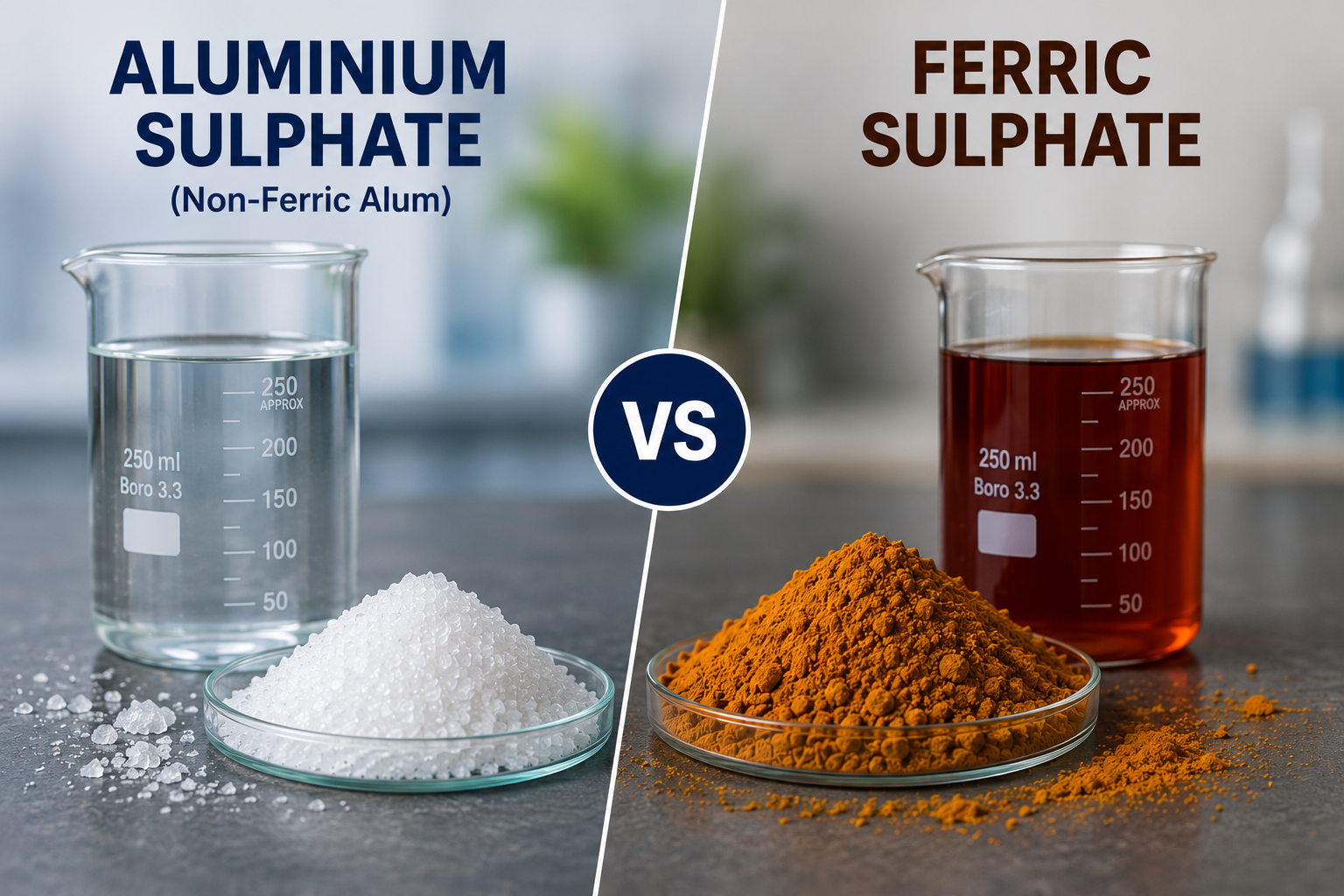
If you run a water treatment plant, you’ve likely been told one of these chemicals is simply “better.” The truth is more useful: each coagulant performs differently depending on what’s in your water. Here’s a clear breakdown of how they compare and why a third option solves a problem both of them share.
What Is Aluminium Sulphate?
Aluminium sulphate (Al₂(SO₄)₃·18H₂O) is one of the most widely used coagulants in water treatment worldwide. When added to raw water, it reacts with alkalinity to form aluminium hydroxide flocs sticky particles that trap suspended solids, bacteria, and colour-causing compounds, allowing them to settle or be filtered out.
Common forms: powder, granules, lumps, or liquid solution Iron content in standard grade: up to 1.5% Iron content in non-ferric grade: 0.01% or below
Where it’s used: municipal drinking water, effluent treatment plants, paper manufacturing, textile dyeing, sugar refining, and construction.
What Is Ferric Sulfate?
Ferric sulfate (Fe₂(SO₄)₃) works on the same principle it forms metal hydroxide flocs that capture particles but uses iron instead of aluminium as the active coagulating ion. This chemistry difference drives most of the performance gaps between the two.
Common forms: yellowish-brown granular solid or liquid solution
Where it’s used: drinking water treatment, industrial wastewater, phosphate removal, sludge conditioning, and pre-treatment ahead of membrane filtration.
Key Performance Differences Between Aluminium Sulphate vs Ferric Sulfate
| Parameter | Aluminium Sulphate | Ferric Sulfate |
| Chemical Formula | Al₂(SO₄)₃·18H₂O | Fe₂(SO₄)₃ |
| Optimal pH Range | Narrower best around pH 6–8 | Broader effective across wider pH window |
| Typical Dosage | Slightly higher per litre in some cases | Often lower for comparable results |
| Sludge Characteristics | Lighter, more voluminous floc | Denser floc, settles faster |
| Corrosivity | Mild manageable with standard equipment | More corrosive needs resistant storage |
| Residual Colour Risk | Iron impurities can cause yellow tint | Rust-coloured residue if overdosed |
| Alkalinity Impact | Consumes alkalinity during reaction | Often needs additional alkalinity dosing |
Which Removes Contaminants Better?
Turbidity Removal
Research shows mixed results depending on conditions. In some long-term studies, aluminium sulphate removed turbidity more efficiently than ferric sulfate, with ferric sulfate’s performance declining during colder months. In other controlled jar tests, ferric chloride showed higher turbidity removal at optimum dosing. The takeaway: turbidity performance depends heavily on temperature, raw water composition, and dosing neither coagulant has a consistent universal edge.
Natural Organic Matter (NOM)
The research is more consistent here. Ferric sulfate coagulation removes roughly 10% more natural organic matter overall compared to aluminium sulphate, with the biggest difference in mid-range molecular weight compounds. However, aluminium sulphate more effectively removes larger organic molecules (~5 kDa), while ferric sulfate performs better on smaller molecules (~3 kDa). They’re not doing the same job they’re removing different fractions of the same organic load.
Practical takeaway: If your raw water is primarily turbidity-driven, aluminium sulphate is often the more predictable performer. If it carries significant dissolved organic colour, ferric-based coagulants typically remove more of it.
The Hidden Iron Problem Both Coagulants Share
Here’s something most comparisons miss: standard aluminium sulphate isn’t iron-free. Commercial grades can contain up to 1.5% iron impurities. That means in colour-sensitive applications, standard alum carries a version of the same risk ferric sulfate is more commonly criticised for.
What iron contamination causes:
- Drinking water: Iron carry-over causes consumer complaints about water colour, even when turbidity and microbial tests pass every regulatory check.
- Paper manufacturing: Iron impurities cause white paper to yellow over time a defect that often isn’t visible until after the product has shipped.
- Textile dyeing: Iron contamination shifts dye colour and creates batch-to-batch inconsistency that’s expensive to trace back to its source.
For most general water treatment, trace iron is a non-issue. But for drinking water, white paper, or textiles, even small iron impurities create visible, measurable problems.
Non-Ferric Aluminium Sulphate: The Iron-Free Solution
Non-ferric aluminium sulphate is a refined grade of Al₂(SO₄)₃·18H₂O manufactured to keep iron content at 0.01% or below roughly 100 times lower than standard commercial alum. The coagulation chemistry works exactly the same way; what changes is purity.
This reframes the original question. The real choice isn’t between two coagulant families it’s between iron-contaminated coagulation (whether from standard alum or ferric sulfate) and iron-free coagulation. Non-ferric aluminium sulphate delivers the turbidity-removal strength alum is known for, without iron carry-over risk.
Available forms:
- Powder (20–80 mesh): Quick dissolution; suited to rapid-dosing systems in water treatment plants and paper mills.
- Granules: Controlled, slower dissolution with less dust; suited to textile and sugar industry metered dosing.
- Lumps: Used in large dissolution tanks in construction and bulk industrial settings.
Which Coagulant Fits Your Industry?
Drinking water treatment: Both coagulants are used globally, but where colour purity matters, non-ferric aluminium sulphate removes a variable that both standard alum and ferric sulfate introduce. Plants with turbidity-heavy raw water tend to favour aluminium-based coagulation; those dealing with significant organic colour may lean toward ferric-based treatment.
Wastewater and effluent treatment (ETP): Ferric sulfate’s strength in phosphate removal makes it a strong candidate where nutrient discharge limits are a concern. Aluminium sulphate remains effective for general solid-liquid separation and BOD/COD reduction. Many ETP operators use both at different treatment stages.
Paper and pulp manufacturing: Non-ferric aluminium sulphate has a clear advantage here. It works as a sizing agent that controls porosity and improves surface finish and because it’s iron-free, it doesn’t contribute to the yellowing that affects white paper products over time.
Textile dyeing and sugar refining: Non-ferric aluminium sulphate improves dye binding and colour fastness without iron-related colour shift in textiles. In sugar refining, iron-free grades maintain colour grade and crystallisation quality both of which directly affect product value.
Can You Use Both Together?
Yes and some plants do. A common approach is to use aluminium sulphate as the primary coagulant for turbidity removal during most of the year, then supplement with ferric sulfate during periods of higher organic colour load such as after heavy rainfall events. This treats the two chemicals as complementary tools rather than competing options.
Decision Checklist For Right Coagulant
- Primarily turbidity-driven raw water with stable pH? → Aluminium sulphate is typically the more predictable starting point.
- Significant dissolved organic matter or colour? → Ferric sulfate may remove more of that load.
- Phosphate removal required in wastewater discharge? → Ferric sulfate’s phosphate-binding properties are a relevant factor.
- Significant pH fluctuation across the year? → Ferric sulfate’s broader effective pH range may reduce the need for constant correction.
- Colour purity required (drinking water, white paper, dyed textiles, clarified sugar)? → Specify non-ferric aluminium sulphate (Fe ≤ 0.01%).
- Uncertain? → Run a jar test with both coagulants on your actual raw water before making a procurement decision.
What to Look for in a Non-Ferric Supplier
Confirm iron content in writing don’t accept a vague “low iron” claim if your application requires Fe ≤ 0.01%. Verify that any certification (such as IS 260:2001) applies to the specific grade and batch you’re ordering. Request a Certificate of Analysis (COA), Safety Data Sheet (SDS), and Technical Data Sheet (TDS) for a recent production batch before placing your first order. Confirm the physical form matches your dosing infrastructure.
Conclusion
Neither aluminium sulphate nor ferric sulfate is a universal “better” coagulant. Aluminium sulphate tends to be more predictable for turbidity-driven raw water and is gentler on standard dosing equipment. Ferric sulfate offers a broader effective pH range and stronger phosphate removal, making it valuable in certain wastewater applications.
What both share is a vulnerability to iron-related discolouration whether from ferric sulfate itself or from iron impurities in standard-grade alum. For applications where colour purity is non-negotiable, non-ferric aluminium sulphate (Fe ≤ 0.01%) addresses this shared weakness directly.
The most practical approach: test both against your actual raw water, understand which contaminants dominate your treatment challenge, and choose or combine accordingly.
📩 Get in touch
📩 Email: info@globexventure.com
🌐 Website: www.globexventure.com
📞 Call: +91 92270 07600 / +91 76003 86854