
Buying sodium citrate in bulk is a lot different from buying a small lab pack. When you order tonnage quantities for food, beverage, pharma, or industrial use, one wrong choice of supplier can cause inconsistent pH, failed lab tests, delayed shipments, or even a rejected export shipment. That is a lot to risk on one decision.
Sodium citrate is a white crystalline powder used as a buffering, chelating, and emulsifying agent. It is found in soft drinks, dairy products, medicines, cosmetics, detergents, and water treatment plants.
Because it is used in so many industries, buyers need to be careful when picking a supplier.
This guide explains exactly what to check before you place a bulk order for a sodium citrate supplier, so you can buy with confidence instead of guessing.
What Does “Reliable” Actually Mean for a Sodium Citrate Supplier?
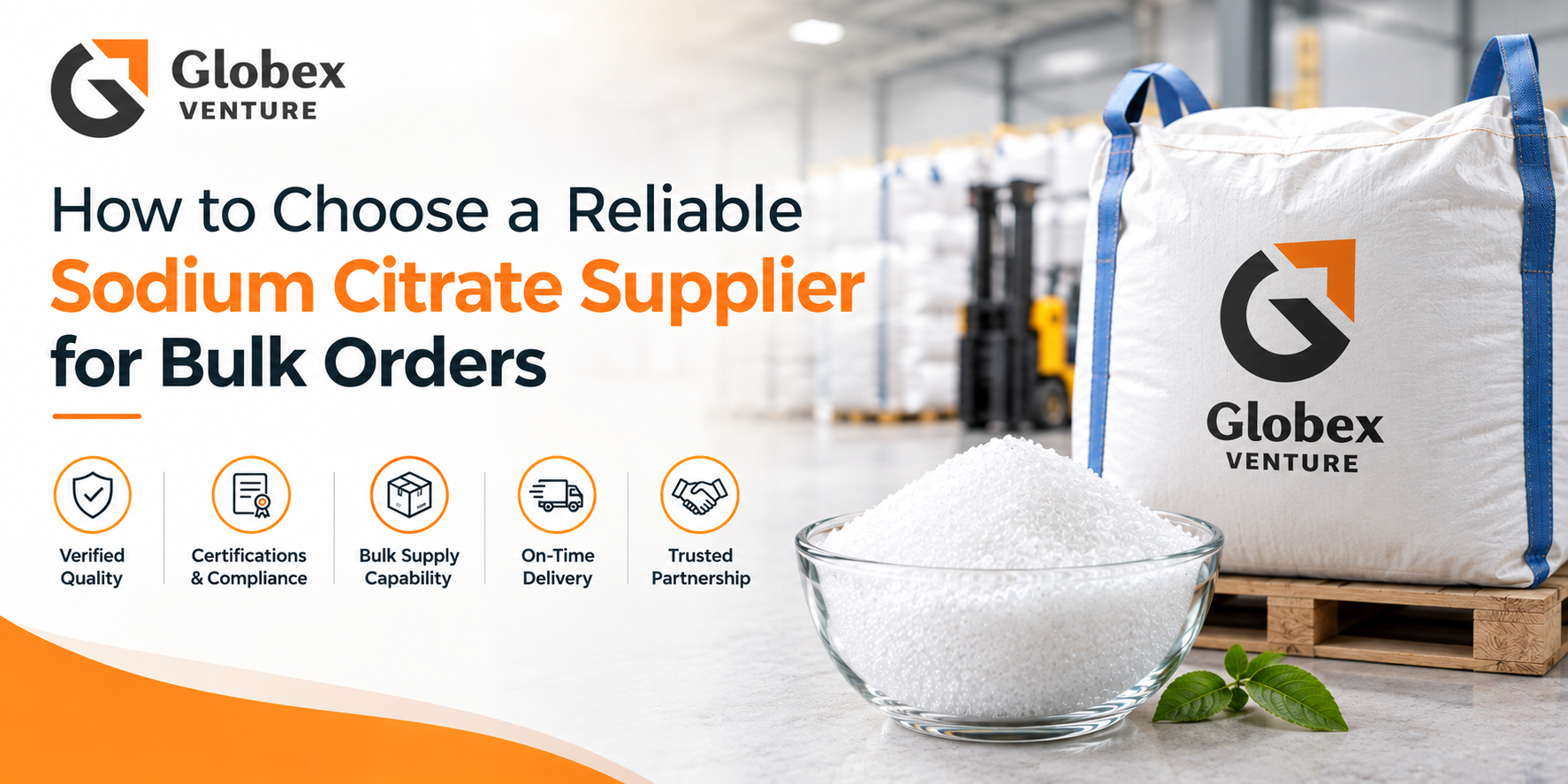
For a bulk buyer, reliability comes down to a few simple things you can actually measure:
- The purity and quality stay the same from batch to batch
- The paperwork matches what actually arrives in the bag
- Orders arrive on time, whether local or export
- Pricing is clear, with no hidden costs
- The team answers questions quickly and clearly
If a supplier does all of this well, they are reliable. If the only thing they offer is a low price, that is a warning sign, not a good deal.
Key Factors to Check Before Placing a Sodium Citrate Bulk Order
1. Product Specifications and Purity Levels
Before anything else, ask for the full specification sheet. A genuine industrial-grade sodium citrate supplier should give you exact numbers, not vague words like “high purity.” Here is what to check:
- Assay (on anhydrous basis): should be around 99.0% to 101.0%
- pH of solution: usually between 7.5 and 9
- Water content: usually 11.0% to 13.0% for the dihydrate form
- Heavy metals and arsenic limits: arsenic should not be more than 2 ppm, heavy metals not more than 10 ppm
- Chloride, oxalate, and sulphate limits: each should stay within small trace amounts
If a supplier will not share these details clearly, that is a bad sign.
2. Technical Data Sheet (TDS) and MSDS Availability
Every good supplier should be able to give you a Technical Data Sheet (TDS) and a Material Safety Data Sheet (MSDS) for sodium citrate right away. These are not just formality documents. They help you clear customs, pass internal quality checks, and meet safety rules.
A good TDS should include:
- Product details (chemical name, CAS number, molecular formula and weight)
- A full specification table (description, solubility, identification test, pH, impurities, assay)
- Storage, handling, and shelf life information
- Hazard classification under GHS
A good MSDS should cover all 16 standard sections. This includes hazard identification, first aid steps, fire fighting steps, handling and storage, exposure controls, physical and chemical properties, and regulatory information. If a supplier can only give you a one-page “quality certificate” instead of these full documents, their quality system may not be strong enough for bulk trade.
3. Manufacturing Standards and Certifications
For food, pharma, and cosmetic-grade sodium citrate, certifications are not optional. They prove the product is safe to use for its intended purpose. Look for:
- FSSAI approval for food-grade material sold or made in India
- ISO 9001 / ISO 22000 for quality and food safety management
- Compliance with Codex Alimentarius or FCC (Food Chemical Codex) standards for international buyers
- A valid Certificate of Analysis (COA) for each production batch
Ask the supplier to match the COA to the exact batch you are receiving, not an old sample report from months ago.
4. Packaging and Bulk Supply Capability
Bulk orders need packaging that keeps the product safe during long transport, whether by road or sea. A good sodium citrate supplier should offer:
- Standard packaging in 25 kg HDPE bags with an inner liner to keep out moisture
- Custom packaging if you need it
- Enough production capacity to handle bulk and export orders without delays
Ask the supplier directly about their monthly production capacity and current order backlog. If they cannot answer clearly, they may struggle to deliver a large order on time.
5. Storage, Handling, and Shelf Life
Sodium citrate is stable and not hazardous, but poor storage can still cause caking, contamination, or quality problems before it even reaches you. A reliable supplier should follow and explain good practices, such as:
- Storing it in a cool, dry, well-ventilated place away from moisture and sunlight
- Keeping packaging sealed to avoid caking or contamination
- Keeping it away from strong acids and oxidizers
- Giving a clear shelf life, usually 24 months under proper storage
Suppliers who explain these details clearly usually run tighter warehouses overall.
6. Regulatory and Transport Compliance
For bulk and export orders, clear regulatory information avoids costly delays. Sodium citrate is generally:
- Not classified as hazardous under GHS (Globally Harmonized System)
- Not given a UN Number
- Not regulated for transport under ADR/RID, IMDG, or IATA rules
Shipping is usually simple because of this. Still, a trustworthy supplier should confirm this in writing instead of leaving you to assume it, especially if you are importing into a country with strict customs rules.
7. Pricing Transparency and Payment Terms
Very low price quotes are one of the most common traps in bulk chemical buying. Before you sign a purchase order, make sure you know:
- Whether the price includes packaging, freight, and insurance, or is ex-works only
- The minimum order quantity (MOQ) for bulk pricing
- Accepted payment terms (advance payment, LC, or credit terms for repeat buyers)
- Any extra charges for custom packaging or faster shipping
A supplier who explains all of this clearly from the start is much less likely to surprise you later.
8. Communication, Responsiveness, and Track Record
Do not ignore the human side of sourcing. A reliable supplier should:
- Answer technical questions with real details, not just sales talk
- Share references or past export history when asked
- Give you one clear point of contact for your account
- Be honest about delivery timelines, including possible delays
If it is hard to get a clear answer while you are still just asking questions, expect the same problem after you place the order.
Why Buyers Choose Globex Venture for Bulk Sodium Citrate
Globex Venture supplies high-purity, industrial-grade Tri Sodium Citrate (Sodium Citrate Tribasic Dihydrate, CAS No. 6132-04-3) for food and beverage, pharmaceutical, cosmetics, water treatment, leather, and detergent uses.
Our product meets a strict specification: assay of 99.0% to 101.0% on an anhydrous basis, pH between 7.5 and 9, and low limits on arsenic, heavy metals, chloride, oxalate, and sulphate.
We provide full documentation, including the Technical Data Sheet and Material Safety Data Sheet, with every bulk order. This gives your team everything needed for quality checks and customs clearance. Standard packaging comes in 25 kg HDPE bags with an inner liner, and custom packaging is available for buyers with special export needs.
Looking for a dependable sodium citrate supplier for your next bulk order? Explore our Sodium Citrate product page or contact our team for a quote and sample documents.
FAQ
- What should I check first when choosing a sodium citrate supplier? Start with the specification sheet: assay percentage, pH range, and impurity limits. Then ask for the TDS and MSDS. These documents tell you more about a supplier than any sales pitch.
- Is sodium citrate classified as a hazardous chemical? No. Sodium citrate is not classified as hazardous under GHS, has no UN Number, and is not regulated for transport under ADR/RID, IMDG, or IATA.
- What is the typical shelf life of sodium citrate? With proper storage, cool, dry, and away from moisture and sunlight, sodium citrate usually has a shelf life of 24 months.
- What packaging is standard for bulk sodium citrate orders? Most suppliers use standard 25 kg HDPE bags with an inner liner. Custom packaging is available on request for larger or export orders.
- Why does the Certificate of Analysis (COA) matter for bulk orders? The COA confirms that the exact batch you are buying meets the agreed specification, instead of relying on an old or generic quality report.
- Can sodium citrate be used across multiple industries from the same supplier? Yes. Industrial-grade sodium citrate is commonly supplied for food and beverage, pharmaceutical, cosmetics, water treatment, leather, and detergent uses, as long as the supplier keeps purity consistent across batches.
📩 Get in touch
📩 Email: info@globexventure.com
🌐 Website: www.globexventure.com
📞 Call: +91 92270 07600 / +91 76003 86854